

Looking to improve your Google Search rankings with your copywriting? You’ve probably heard about the importance of keywords in Search Engine Optimisation (SEO), but how much do you know about long-tail keywords, the little nuggets of specificity that help your content reach a perfectly targeted audience?
Long-tail keywords are an important part of the SEO process and can help you squeeze more out of your content. Here’s your five-minute guide on how to find the right keywords and effectively incorporate them into your strategy.
What are Long-Tail Keywords?
Long-tail keywords are specific and highly targeted phrases typically consisting of three or more keywords. When tailoring your content for SEO, long-tail keywords are crucial for ranking higher in search results and attracting a specific, relevant audience.
To give you an idea of how this works, let’s say someone Googles the word “coffee.” It’s an extremely broad term and so it’s pretty unlikely that they’re going to find exactly what they’re looking for. Now let’s say they type in “best independent coffee shops in London”. It’s a very specific thing to search and they’re going to get far fewer results, but it’s more likely that they’re going to track down the exact information they’re after.
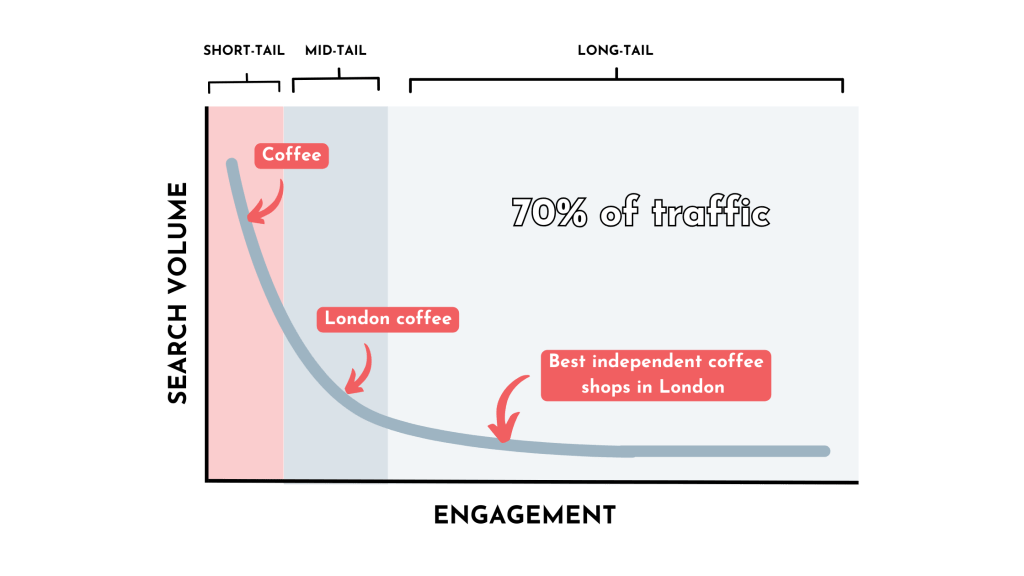
Inspired by Mangools
Why are Long-Tail Keywords Important?
Where do we start? Long-tail keywords have a HUGE number of benefits when used properly (we’ll get to that part next!):
Lower Competition
Because long-tail keywords are so specific and descriptive, they often have much lower competition than broad, popular keywords. This makes it easier for smaller businesses and websites to cut through the noise and rank higher in search results.
Targeted Traffic
When someone uses a long-tail keyword, they’re typically further along in their search and have a specific intent, for example making a purchase or researching a product. Targeting these keywords can help you attract visitors who are more likely to take action, leading to higher conversion rates.
Improved Voice Search Optimization
Did you know that over a billion voice searches are carried out every month? It might surprise you, but this feature is actually a massive part of search marketing nowadays.
Since people tend to use natural language when speaking to voice assistants, this often results in longer and more specific search queries, which is where long-tail keywords can be your best friend.
How Do I Use Long-Tail Keywords in My Content?
Before you can reap the benefits of long-tail keywords, you need to find the right ones to use. So how can you do that?
Set your goals
Your choice of long-tail keywords will depend on what you’re writing about and the purpose of your content. Is it a “best of” list? A product description? A user guide? Knowing exactly what you want to achieve with your content will help you define the best keywords.
Start the process
Next, you want to brain-dump some broad, short-tail keywords that relate to your content. Going back to our London coffee shops example, some words and phrases you might want to include could be coffee, London coffee, coffee shops, or London cafes.
Do the research
Plug these initial ideas into a keyword research tool, such as Google Keyword Planner, SEMrush, Ahrefs, or Wordstream to find other keywords related to your topic or niche, including more specific phrases that your audience might be searching for. Each tool works slightly differently, but all of them will give you a good idea of what keywords you could be using.
Another beneficial step is to analyze your competitors’ content. If you have a specific subject or title in mind, plug it into Google Search and see what type of content comes up. Are the top results mostly blog pages? Are they product comparisons? The best-performing pages related to your idea might help you plan your own content piece and tailor it to user intent. Pasting the URLs of high-ranking content into your chosen keyword tool can also be a speedy way to bring up a list of keywords that your competitors have used to attract organic traffic.
Get writing
Once you’ve got a solid list of both long and short-tail keywords, it’s time to use them! Here are some tips on incorporating them into your content:
- Use your keywords as early on in your text as possible, particularly in your title and intro paragraph. Scatter them throughout the body of your text, too, and in any headings that break up your content.
- Don’t overstuff your content with keywords. Yes, you want your piece to rank highly in Google, but you also want it to sound natural. Repeating keywords over and over isn’t going to create an enjoyable read!
- Write a meta description that includes your main long-tail keyword. This is the snippet that appears in search results and can hugely impact click-through rates.
- Use variations of your long-tail keywords to try and target those people who may word their search a little differently. For example, you could replace “London coffee shops” with “London cafes”.
It can take a little time to perfect the process, but the more you understand what your target audience is searching for, the more you’ll be able to serve them exactly what they want. Sounds like the perfect win-win situation.
 pointwestcreative.com